
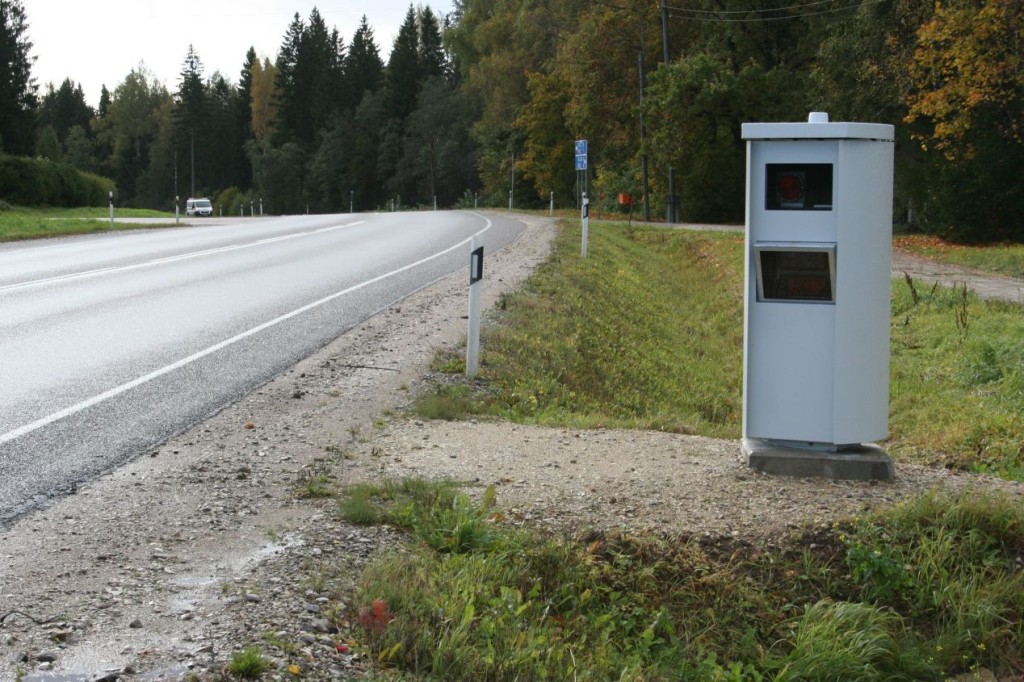
Director General Priit Sauk says the goal of the Estonian Transport Administration is to find effective new ways to improve road safety and reduce the number of fatalities and injuries. “The project revealed that measuring the average speed in the test area resulted in a more uniform flow of traffic, less overtaking and more drivers sticking to the established speed limit,” he explained.
The average speed was measured on four sections of the Tallinn-Narva, Tallinn-Tartu, Tallinn-Pärnu and Ääsmäe-Haapsalu highways, over a total of 32 km. The pilot project, which was designed to monitor the behaviour and changes in behaviour of drivers, was carried out in daylight hours in two stages: the first from 15-24 September 2023, and the second from 28 September-8 October 2023. The speeds of 118,231 motor vehicles were analysed, with around 42,000 of them exceeding the average. The average speed in the testing area was exceeded seven times more than the instantaneous speed at the moment of entering or exiting the testing area.
During the first stage of the project, 39% of vehicles exceeded the average speed; 32% did so during the second stage. Just 8% of vehicles exceeded the speed limit when entering the test area, and even fewer, 5%, did so when exiting the testing area. The highest average, 152 km/h, was recorded in the Tallinn-Pärnu section. The average speed was exceeded most often in the Haapsalu-Ääsmäe section, where the proportion of those who exceeded the speed limit dropped to 12% in the second stage.
Overtaking was most common in the Haapsalu-Ääsmäe and Tallinn-Pärnu sections (over 15%).
During the second stage, the proportion of drivers who did not overtake other cars increased, improving the flow of traffic.
“Based on these results we can say that implementing average speed measurement would definitely have a positive effect on road safety,” Sauk said. “Sticking to the speed limit creates the conditions needed to reduce the number of serious accidents and increase the environmental sustainability of roads.”
According to a study on driving conducted by Turu-uuringute AS in August 2023, 61% of drivers take a positive view of the measuring of average speed in order to increase road safety provided the measuring system does not collect information for other purposes.
In weighing up the implementation of the system, the Estonian Transportation Administration is preparing a procurement entitled ‘Analysis of the implementation, feasibility and cost-effectiveness of automated supervision‘. Whether such a system would be constitutional, infringe on people’s basic rights and be in line with personal data laws will also have to be determined.
The study can be found here.
You can view the data from the pilot project here.

