
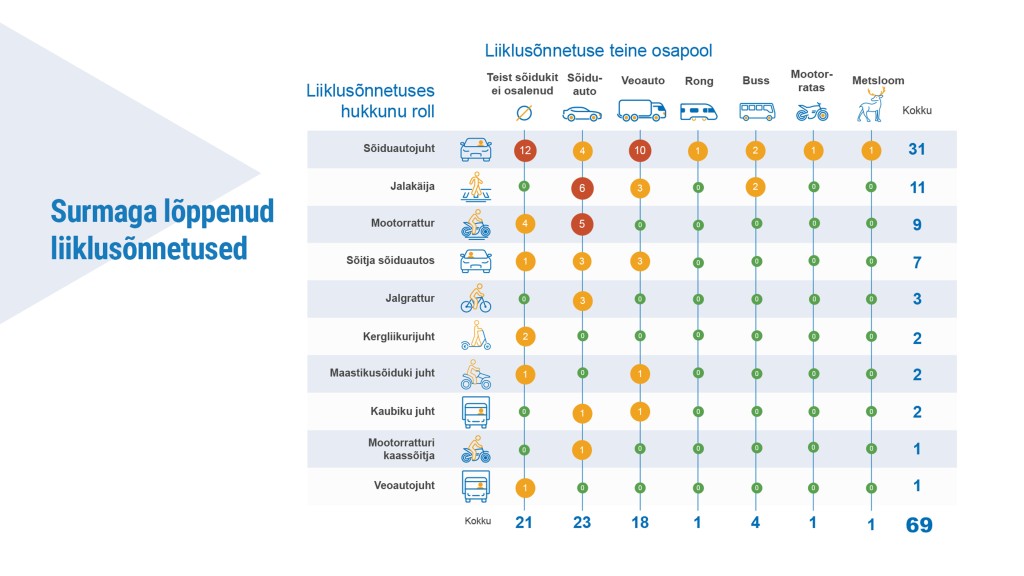
“The safety situation on Estonia’s roads leaves a lot to be desired,” remarked Minister of Infrastructure Vladimir Svet. “The increasing number of injuries and deaths is a cause for concern. We are also seeing, in international comparison, that unlike in the Nordic countries, the number of fatalities per million inhabitants is increasing in our country. It is clear that the current measures are not leading to progress and that we need to consider how to change things for the better.”
Priit Sauk, the Director General of the Transport Administration, says that on average there were five road accidents involving people per day last year. “That means roughly six people being killed or injured for every day of the year,” he explained. “The biggest risk factors remain speeding and drink-driving. Our road culture can only improve if each and every one of us contributes to it. Last year there were just 12 days without accidents that resulted in injuries to people, or their deaths. That is far too low a number. We need to find the means to have a real impact on offenders.”
Lt Colonel Sirle Loigo from the Police and Border Guard Board says that creating a safe environment is not merely the responsibility of a few individuals or interest groups. “A safe environment starts with all of us, whether we are driving a car, walking down the street, crossing the road or transporting passengers,” she noted. “Although the traffic situation was quite bleak last year, we know from previous years that it can be improved if we work together.”
The highest monthly number of road accidents in the last 10 years was recorded in March, May, August, October and November 2024, with 905 accidents in total. The months with the highest number of casualties were June, July, September and December, when a total of 34 people died. The most road accidents – 1024 in total – occurred in Harju County.
Single-vehicle accidents have been the main type of road accident since 2020, accounting for 43% of accidents resulting in death or injuries in 2024. This increase was mainly due to the 28% rise in the number of accidents involving non-motorised vehicles and cyclists.
The main causes of fatalities are similar to previous years: speed, drink-driving, unrelated activities and failure to use safety equipment.
A total of 1,156,500 field sobriety tests were conducted in 2024, almost a fifth more than the year before. Almost 6400 drink-driving offences were recorded during the year, 100 more than in 2023. One in three drivers of non-motorised vehicles injured in road accidents last year were under the influence of alcohol, while 15% of the cyclists involved in accidents were drunk. Drunk pedestrians were involved in 17 road accidents. A total of 121 people were injured and at least 18 were killed in road accidents involving drunk drivers.
More than 89,000 road traffic misdemeanours and just over 2700 road traffic offences were recorded in 2024. Almost 321,000 infringements were detected through automatic monitoring. Compared to 2023, the number of both increased.
More than 3900 infringements of requirements for the use of safety equipment were recorded, marking a 35% increase year on year. There is an increasingly negative trend in non-compliance with child safety equipment requirements, with nearly 360 cases recorded in 2024, or 47% more than in the previous year.
During the year, 11 ship accidents and six dangerous incidents were registered in Estonia’s maritime and inland waters. There were no fatalities, although two people were injured.
More than 2500 incidents were recorded in aviation, four of which were deemed serious. Compared to 2023, the number of reports increased by nearly 20%. This is due to the growth in air traffic and improved reporting culture. There were no fatalities or serious injuries in aviation. The trend in air safety in terms of the ratio of accidents to serious incidents shows a slight improvement compared to 2023.
Last year, the Estonian Transport Administration made 14 road safety hotspots safer, investing a total of €1.8 million in this. Compared to previous years, funding for this measure has decreased significantly, mainly due to a general decrease in investment in the road maintenance plan.
A summary of the year in traffic in 2024 can be found here.

